Showing posts with label Canada. Show all posts

Historical Niagara On The Lake: not just for honeymooners

I am fascinated by European history in Canada and have visited Canada often. But Niagara on the Lake (pop 15,500) seemed to be a post-war honeymoon site and not very historically important. Mea culpa Niagara! The town's historic district was actually designated a provincial Heritage Conservation District in 1986 and a National Historic Site of Canada in 2003.

St Mark's Church, 1792-1808

We need to go back to 1776, when representatives from each of the original 13 American states voted in the 2nd Continental Congress to adopt a Declaration of Independence. In it, they explicitly rejected the British monarchy and Parliament, leaving loyal British subjects with nowhere to live. In 1781 the British government established the town of Niagara just on the Canadian side of the border, presumably to offer a safe haven to British loyalists, during and after the American Revolution.

The location in Ontario could not have been better – just where the Niagara River and Lake Ontario meet. But Niagara’s proximity to Americans on the other side of the border was both advantageous and risky. During the Anglo-American War of 1812, American forces invaded Canada, and captured the town and its fort. Later the Americans pulverised Niagara town as they retreated in Dec 1813.

Prince of Wales Hotel, 1864

Today the Niagara Heritage Trail is a historic route taking in the Canadian coastline of the Niagara River and the Niagara National Historic Sites. Along the route, visitors can visit Old Fort Erie, site of a major battle in July 1812 between the waiting British troops and the advancing American troops. Chippawa Battlefield Park, site of the first major battle on the Canadian side during the War of 1812, is also of interest.

I wondered why so much military effort was put into taking or defending this tiny part of the North American continent in 1812. Clearly the Niagara River provided the vital water transportation route between Lake Ontario and Lake Erie, so perforce the Niagara frontier became the scene of many rather tragic battles. Most of the former military sites, like Fort George (abandoned in 1814), Navy Hall and Butler's Barracks, have been returned to their original condition. Fort Mississauga (built on the lighthouse site in 1814) is also interesting.

And talking of the war (and pubs), examine The Olde Angel Inn, first established in 1789. Captain Colin Swayze of the Canadian Militia wanted a bit of leg-over during the worst of the War of 1812. He hid in the beer cellar but American troops eventually used a bayonet to find him and kill the amorous captain. The Olde Angel Inn was itself burned to the ground during the war, only to be rebuilt three years later along the original plans - including the wooden tables in the dining rooms and exposed beams holding up the roof.

An incomplete St Mark's Church went up in July 1792, even though the nave took another decade to be completed. Thus full services could not be held in St Mark’s till 1808. Alas almost all of this historic institution was burned down in the war of 1812. The British eventually rebuilt the town with lovely Georgian and mid-Victorian architecture, making the streetscapes look splendid. Thankfully St Mark's Church was restored in 1820 and later enlarged.

McFarland House, 1800

McFarland House 1800 was the brick Georgian home of John McFarland and his children, part of the reward granted to the Scotsman in return for his services to King George III. The home was fortunate to have largely survived the burning of Niagara by the Americans in December 1813. This makes McFarland House one of the oldest structures in Niagara-on-the-Lake. During the War of 1812 McFarland House was used as a hospital by both the British and the American armies, and a gun battery was situated on the property to help guard the Niagara River.

Another fiery Scotsman was William Lyon Mackenzie. Born in Dundee in 1795, he moved to Canada in 1820. The Colonial Advocate was a newspaper for which he was the publisher, editor, writer and paper carrier. I have never seen the Mackenzie Heritage Printery and Newspaper Museum, located in Mackenzie’s home, but it is Canada’s largest working museum of printing. And it is recommended in Get Up and Go (summer 2012).
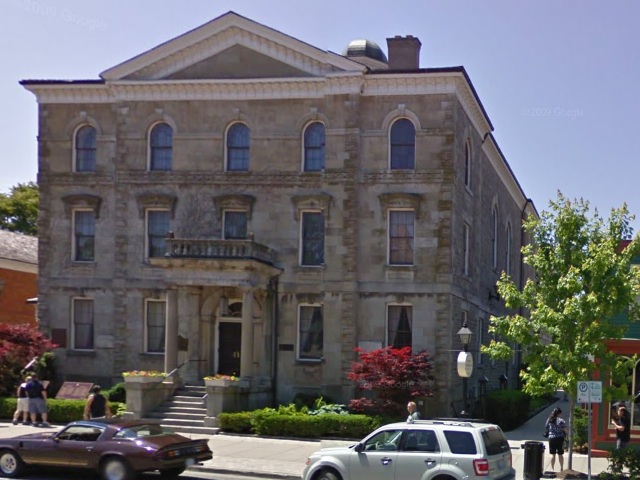
Old Court House, 1847

The Niagara Apothecary is a careful restoration of a pharmacy that had operated in the town from 1820 on. The two arched plate glass windows show an Italianate taste, but it is the interior that is splendid. The lustrous black walnut and butternut fixtures, elaborate plaster rosettes and crystal gasoliers projected an impression of  wellbeing back in 1869, and still look impressive now.

The Court House was designed by a Toronto architect in 1846 and opened in 1847, in the fashionable neoclassical style that everyone wanted for public buildings. Though the courts were moved in 1862, this building is still well used. Today the Old Court House Theatre, located where the Bernard Shaw Festival began in 1962, has a 327-seat theatre in the original Assembly Room.

In 1848, the first bridge opened across the Niagara River. Designed as a suspension bridge for carriages and pedestrians, it was located where the Whirlpool Rapids Bridge is today. It didn't take long before the Great Western Railway reached Niagara from Hamilton, via to the Suspension Bridge. Work then began to rebuild the bridge as a double-deck span, with rail traffic using the upper level while the lower deck was for carriages and pedestrians. The new bridge was opened in 1855.

My favourite of all the Victorian buildings in Niagara is The Prince of Wales Hotel which was built in 1864. It was renovated a hundred years and restored to its original Victorian charm. The hanging baskets of coloured petunias remind me of Victoria on Vancouver Island.

Fort George, built in 1799 and abandoned in 1814. 
The fort was later rebuilt and used by the Canadian Army as a military training base during WW1.

Established in 1961, the Niagara Falls History Museum is nearing the end of major expansion works and will re-open to the public in July 2012. The Battle Gound Hotel Museum is well located in Lundy’s Lane Battlefield but more than that, I think it is very civilised of the Canadians to house this museum in a restored 1850s tavern house.

Apothecary, built in 1820, rebuilt in1869 and recently renovated

William Nicholson and Canada's WW1 generals

I saw the catalogue William Nicholson, British Painter and Printmaker 1872-1949, but only took notice of this artist because he went on to become Ben Nicholson’s father.

No starving artist was William Nicholson. He was born into a prosperous Nottinghamshire family who made their money from the ironworks that specialised in agricultural machinery. When William was in primary school, his father was elected a Tory MP and a year later the son was sent to a classy boarding school.

Luckily for William, the nightmare of being in a boarding school was relieved by the intervention of the drawing master who encouraged and coached the lad. Eventually the young man went to Paris to study life drawing at the Académie Julian, only recently the home of founder members of the Nabis, passionate about Gauguin’s art. For William, the Louvre was another French joy where he developed an interest in C17th Spanish painting, making copies of a Velásquez’s works.

My interest in William Nicholson was piqued in relation to WW1. Although not necessarily a painter of modern life, a number of works relating to the war suggested he understood the mechanisation of slaughter very well. Thus the very large painting called Canadian Headquarters Staff, with its group of officers semi-posed against a backdrop-photograph of the bombed-out Cloth Hall at Ypres, became very important.

Firstly it was commissioned in 1917 as part of a commemoration of Canadian sacrifice and heroic effort in the Great War. The painting, on loan in 2004-5 to the Royal Academy from the Canadian War Museum in Ottawa, had never been exhibited before outside Canada.

Secondly it was huge (2.4 x 3.1 ms), cleverly designed and not at all absorbed with nationalist glamour and theatrical drama. If the commissioners of the painting had hoped to see glorious Canadian soldiers on rearing horseback a la Napoleon, they would have been sorely disappointed.

Nicholson, Canadian Headquarters Staff, 1918. Beaverbrook Collection of War Art, Canadian War Museum, Ottawa.

I would love to see the original brief – what did the commissioners of this painting want Nicholson to depict? What did they hope the painting would say to its Canadian audiences? The painting, originally commissioned by Lord Beaverbrook but quickly forgotten, was rediscovered in the vaults of the Canadian War Museum. Nicholson captured the officers in the moments before they sat for an official portrait. Unconventional for the officers' ordinary stance, it has been argued that Nicholson may have viewed his subjects with cynicism. Well, YES! But we don’t even know if the painting was properly finished or not by 1918.

The six senior officers, 5 generals and a major, could have been about to roll up their papers and go off for a spot of tea. So what set the scene firmly in the nightmare of WW1? Their uniforms of course, smart, polished and clearly Canadian. And behind their heads was a full length backdrop on the wall. The Cloth Hall of Ypres behind them was a still from the dreadful newsreel of destruction and misery that had shocked the world. In sepia.

William Feaver wrote “what Nicholson was at pains to suggest could only be that the generals’ responsibilities were, so to speak, their backdrop. Cause and effect loomed over them. Their troops had proved themselves at the Second Battle of Ypres, in April 1915; they had been the first to suffer onslaught by poison gas; Ypres had become a ruin. And here, in his studio, with his civilian hat and coat laid on the chair at the left, Nicholson created a war tableau devoid of both poignancy and bellicosity”.

The Telegraph said he painted in a bravura style that we associate with late Victorian and Edwardian artists such as John Singer Sargent. So historically, William belonged at the tail end of the C19th's dialogue between painting and photography, not at the beginning of the C20th's analysis of the nature of visual, spiritual and psychological experience.

Yet … yet…. William was still working on the picture when, a month before the war ended, he learned that his own son Tony had been killed in battle. Nothing can ever prepare parents for the death of their child, even in war time. So perhaps Feaver was correct; the generals paraded not authority but wariness. The generals KNEW what ordinary mothers and fathers could only FEAR.

Nicholson was knighted in 1936. All in all, we assume he would have happily given his knighthood back, if only it would have brought his son Tony back to life.

WW1: from national heroines to national embarrassments

By 1914 a quarter of all British women were already in paid jobs. Yet it was only during WW1 British women were called on, by necessity, to do more work and to take on newer roles that were beyond traditional community expectations. Once the men left home and the family received only the breadwinner’s poor army pay, most women had to seek paid employment for the sake of their families’ survival. Or because they wanted to Do Their Bit in a desperate time for the nation. Or because they wanted to leave their parents’ home and get involved in exciting employment possibilities.

Poster, VADs were urgently needed

Government encouragement made the workplace accessible, gave the industrial environment respectability and encouraged a choice of industrial employment. In Britain nursing services like the Queen Alexandra's Royal Army Nursing Corps had started before WWI. But from 1914 on, recruitment for the Voluntary Aid Detachment (VADs), in particular, intensified. Posters across Britain stated that ward assistants, ambulance drivers and kitchen staff were urgently needed. These brave women were allowed in the front line within one year of the war starting (1915) and increased their skills so quickly that professional staff started to admire the VADs' contribution.

Poster, WRAF needed women's particiation

While older or less confident women were often involved in voluntary work eg serving at the Red Cross, the majority of young women took over real jobs that men had done. They worked in munitions factories, offices and large hangars used to build aircraft. Did the unions, who had fought for male workers’ rights against brutal capitalist opposition for decades, support women workers as vigorously? It would seem not, especially in the important highly skilled industries like engineering and ship building. Perhaps the unions already predicted the end of WW1 and wanted to ensure that every soldier would have a job to go back to. In any case, where unions did allow women to take over skilled jobs, the employers had to agree to sack the women as soon as the war ended.

Poster, WAAC, every fit woman can release a fit man

The Women’s Army Auxiliary Corps (WAAC), which started in July 1917 with Dr Mona Chalmers-Watson as the Chief Controller, was the star attraction for women. Recruitment posters for the WAAC proclaimed that “Every fit woman can release a fit man”, and not surprisingly, endless numbers of women responded. But even life in the WAAC was not a doddle. In the lower ranks, unskilled work was paid at the rate of 24 shillings a week while shorthand typists could earn twice as much. Although uniforms and accommodation were free, money was deducted each week for food.

There was no work that women in the WAAC and other sites could not do. The Imperial War Museum has photos that show women doing heavy, dirty or even heart breaking work eg members of the WAAC's tending the graves of Allied soldiers. When compulsory male conscription was introduced in 1916, a competent female workforce became even more important. Restrictions that had denied access to particular trades were forgotten for the rest of the war, and women did work they were previously thought incapable of eg coal hauling and ship building.


 WAAC's tending the graves of Allied soldiers in Abbeville in France, 1918. Imperial War Museum photo

In Canada, recruiting of women intensified. Women trained to be munitions workers so that they were ready to move into factories; Canada could answer the call to nationalism with her Dependables.  Thousands of other women were helping with agricultural work via Canada’s Women’s Land Army. “The world with difficulty accustomed itself to the thought of women facing real danger and doing arduous work”. No occupation, including quarrying and mining, should be considered closed to women as “every one knows that the Canadian woman is a real Dependable!” She served her nation and the British Empire.

In Australia WW1 was a genuinely liberating experience for many women;  it made them feel useful as citizens and it also gave them the freedom and the wages only men had enjoyed so far.  Women joined the workforce between 1914-18 in Government departments, public transport, the post office, as clerks in business, as land workers and in factories, especially in the dangerous munitions factories. Women did very well, surprising men with their efficiency and their ability to undertake heavy work. By the mid war they were already regarded as a force to be proud of, part of the glory of the British Empire. Undoubtedly, however, the Australian unions were as worried about male workers coming home after the war as were the British unions.

Poster, women were needed to work with planes

If ever there had been confusion about the value of women’s work in Britain and the Empire, these heroines showed that women were highly capable of learning, training and working in very different fields. Although women were still paid less than men had been pre-war, women's equality was at least on the agenda by war’s end. The women workers had helped to save their nation in time of need, had improved their own individual lives and were changing the notion about women’s role in society.

Find a fine paper called WOMEN AND WORK IN WARTIME BRITAIN by Deborah Thom

**

The really radical question was not “were women allowed to work in real jobs during the war?” but “what happened to those women once the war ended?”

Lucy Noakes suggested that the proposed emigration of large numbers of single women to the Empire in the aftermath of WW1 was one of the main ways Britain got rid of its "excess" single women. Although they had worked during the war and contributed enormously, they were a national embarrassment by 1919. They were forced to leave their exciting, meaningful jobs and were asked to go into domestic service. Worse still, so many men had died in the trenches in France and the Lowlands that these excess women would never find husbands or have babies in Britain.

Noakes said that women who refused to go into domestic work were vilified by the press as “ruthless self seekers, depriving men and their dependants of their livelihood”, or “leeches and parasites determined to have the time of their lives at the expense of the returning men and of wider society”. Women who had served in uniform were often depicted with particular venom. “Those women were bold and masculine, cigarette smoking.., with a loss of grace and charm”.

Thousands of women were asked to emigrate from Britain for new lives in Canada, Australia and New Zealand. And although British women were willing to do exactly that (see the lines at Australia House in London), the irony was that these New World nations actually wanted women to be domestic servants and simple labourers for farms. Again! Once the soldiers returned home from Europe, these New World countries did NOT want female engineers, aeroplane makers and repairers, ambulance drivers or ammunition manufacturers taking the men’s jobs.

Single working women queued up at Australia House, 1919, to emigrate

Did the British manage to offload their unwanted women workers? Did Australia, Canada and New Zealand give them new homes, husbands and meaningful jobs? It would seem not. The British government launched the Free Passage Scheme in 1919 for ex-servicemen and their dependants. But by 1922, when the scheme closed down, only 5% of the migrants had been single women with years of working experience during WW1.

While Noakes judged the Free Passage Scheme a failure, based on the small number of working women who participated, others have pointed out that working  women's participation was never the primary aim of the scheme.


Women's Institutes - "For Home and Country"

Women’s Institutes originated in Canada in 1897, as a direct result of the work done by a Mrs Adelaide Hoodless (1857-1910). Hoodless had been pushed into advocacy when her youngest son died in infancy after drinking impure milk. Along with farmers Erland and Janet Lee, Hoodless drafted the charter for the Women’s Institute movement and helped organise the first Institute at Squire’s Hall, in rural Stoney Creek, Ontario.

The 1897 meeting planned a path for the Federated Women’s Institutes across Canada. The women affiliated to the Farmer's Institute and actively pursued the support of the Minister of Agriculture. Government cooperation was important from the start of the organisation.

Erland and Janet Lee Museum, Hamilton, Canada.

In 1910 Mrs Hoodless made an appeal for a university faculty of Home Economics. Although she didn’t live long enough to see it, Hoodless had done the pioneer work for the founding of a Department of Household Science at Toronto University. She organised Household Science classes at the YWCA in Hamilton and persuaded the Province of Ontario to undertake a province-wide programme. She influenced Lord Strathcona to assist in financing the Ontario Normal School of Domestic Science and Arts in Hamilton in 1900. Mrs Hoodless convinced tobacco millionaire Sir William Macdonald to contribute financially to the establishment of Macdonald Institute, Guelph and to Macdonald College, Quebec.

In 1915 the Agricultural Organisation Society in Britain, under the Ministry of Agriculture, were looking to Canada to start a similar organisation in the heart of the British Empire. The object of the Agricultural Organisation Society was to organise farmers into co-operative societies for the purchase of agricultural requirements and for the sale of produce. So they invited a Mrs Madge Watt, who was visiting from Canada, to address them.

Clearly the British men saw the value of the Women’s Institute movement in war time, to get rural women working co-operatively and to increase food production. The first Institute in Great Britain was started that year in Llanfair PG in Wales. And the Scottish Women’s Rural Institutes soon became very popular as well.

From 1915 – 1917, the British Women’s Institutes adopted rules specifically based on the Canadian model and agreed that they would:
a) study home economics;
b) provide a centre for educational and social intercourse and for all local activities;
c) encourage home and local industries;
d) develop co-operative enterprises; and
e) stimulate interest in the agriculture industry.
From 1917-1919, under the Board of Agriculture, the same Women’s Institutes concentrated on food production to help the war effort.

Women's Institute meeting, 1920s

Two publications appeared in Britain. The Landswoman, shared with The Women's Land Army, appeared from 1917-1919. After 1919, a subscription magazine called Home and Country was published monthly.

How many women became members? The British membership is said to be 210,000 in any given year. Would that number have risen during the two world wars?

The idea of Women’s Institutes was first introduced to New Zealand by Miss Ann Spencer on her return from war work in England, where she had seen the organisation in action . In Feb 1921, in conjunction with Mrs Francis Hutchinson, Spencer formed the Rissington Women’s Institute in Hawkes Bay, and thence to the rest of the country. It is interesting to note that, whereas Institutes in other countries had received financial assistance from their Governments, the movement in New Zealand had been built up solely by the endeavours of the members themselves. A request in 1927 for government assistance was refused.

ANZAC Day Commemoration Committee noted that a number of women’s organisations in Australia became very active during WW1, including the Australian Women’s National League, Australian Red Cross, Country Women’s Association, Voluntary Aid Detachment, Australian Women’s Service Corps and the Women’s Peace Army. The trouble is, I can’t find any mention of a branch of the Country Women’s Association before the NSW branch was formed in 1922. It started at a Bushwomen's Conference held in conjunction with the Royal Agricultural Show in Sydney.

In its written history, this Australian branch tied itself back to the same Mrs Hoodless in Canada. But was there really any connection between Canadian, British, New Zealand and Australian country women? The CWA in Australia has generally been a  conservative organisation. Yet while the CWA in many ways defended traditional gender roles, it has occasionally been a progressive force - eg consider its encouragement of rural women to take an active part in public affairs or in environmental issues. As early as 1936, for example, the NSW branch passed a resolution in favour of equal pay for women.

In general, Canada, Britain, Australia and New Zealand all placed a strong emphasis on community service and personal growth for rural women. But I suppose each national federation of women’s institutes had its own priorities – one wanted a body that could support women in rural communities, a second might have wanted to build domestic science classes for female students and a third might have been mobilising women for war work. What they did NOT do was concentrate solely on baking fluffier scones or making more succulent orange marmalade.

The goals were best specified in the 1920s when the British women agreed “to improve and develop conditions of rural life; to give to all country women the opportunity of working together through the Women's Institute organisation; to provide for the fuller education of countrywomen in citizenship, in public questions both national and international, in music, drama and other cultural subjects; and to secure instruction and training in all branches of agriculture, handicrafts, domestic science, health and social welfare”. Clearly the important and shared role in every country was to reduce rural isolation, give women an opportunity to develop confidence in their views and to participate in relevant health, welfare and educational projects.


The Women's Institute, a history of the British movement written by Susan Cohen

Simon Goodenough wrote Jam and Jerusalem: A Pictorial History of the Women's Institute, published by Collins in 1977. Jane Robinson wrote A Force To Be Reckoned With: A History of the Women's Institute, published by Virago in 2011. The Women's Institute by Susan Cohen came from Shire Publications in 2011.

Rev. Thomas Oliver - Canadian inventor, USA businessman

The Oliver typewriter was invented in the 1890s by a Canadian minister from Ontario, the Rev Thomas Oliver (1852-1909). The minister wrote at least one sermon a week, plus speeches at weddings, funerals and baptisms. He needed to stand in the pulpit and read clearly to his awaiting congregation, not stumble over illegible hand writing. So like every doctor and cleric before him, this reverend gentleman had to deal with his legibility problem.

Oliver type writer, 1895 production type

In 1888, Oliver began to develop his first typing machine made from strips of tin. After years of development, he had developed a prototype model, composed of 500 parts. I don’t know why the good businessmen of Ontario didn’t invest in the machine. But if Rev Oliver was going to realise his dream, he felt he had to move to Epworth Iowa, continue his work with the Methodist church and look for investors.

He married Mary Ann Eddy, a Canadian, and had two children, but I cannot find what happened to her.  The second wife was also a Canadian who moved withRev Oliver after he decided he would be more successful south of the border. The children of the second marriage were born in the USA where he resigned his ministry and threw himself full time into inventing.

Conventional typewriters then had the type arms laying on a bed in a well in the bottom of the machine. When the key was struck, the arm rose up in an arc and hit the page on the platen above it, before falling back into place. Why not, Oliver proposed, mount the arms in twin towers, above the platen, on either side of the typewriter. Thus his arms would utilise gravity by falling from the towers when struck, down on the platen.

I don’t know if he specifically wanted the user to see what he/she was typing – perhaps it was just serendipitous. But having the type-bars swing down to the platen from the two type-bar towers allowed for "visible typing". In addition, Oliver mounted the type face in the middle, creating a sturdier machine.

1904 advertisement for Oliver Typewriter (called the visible writer)

The Oliver Typewriter Co. was incorporated in 1895 and immediately begun operating in the USA, with its tiny administrative headquarters in Chicago. Then in 1907 the company took the first five floors of the Oliver Building which was build in North Dearborn Street, Chicago.

Soon the manufacturing sector of the business moved from Iowa to a factory in Woodstock, Illinois on a 12 acre lot next to the Union Pacific railroad. This was the real home of The Oliver Typewriter Company. Employee recreational activities included a company band and baseball team. Oliver built a bandstand for the Oliver Typewriter Band in Woodstock's Square in 1908.

Not only was the design clever, but so was the method of sales - the company established sales networks by encouraging customers to become local distributors. Although I have seen paid advertisments in newspapers and magazines, it seemed that world of mouth advertising was cheaper and more effective.

Thomas Oliver died in 1909 so he didn't see his company's sales go gangbusters. When the company was at its peak, some 400 typewriters were produced daily and sold. The Oliver Typewriter Co. employed 875 workers in the Woodstock factory alone, and there were branch offices across the USA including Baltimore,  New York, San Francisco and Seattle. Only when they changed sales tactics to a mail-order scheme in 1917 were the branch offices closed.

Competition and a recession in 1921-1922 caused many customers to default on their payments. In 1926 the board decided to liquidate, so the American plant closed and the company moved to the UK, becoming the British Oliver Company.

The Rev Thomas Oliver (1852-1909)

Sometimes I find information in amazing sources eg the Canadian Boer War Museum. The Oliver Typewriter had a slow start in the early 1890s but became popular just as the Boer War was reaching its worst era in 1900-1901. During the war this would have been the typewriter used to send messages or to type up news stories. The Canadian Boer War Museum was keen to add the machine to its collections, in order to preserve important Canadian heritage memorabilia.

Maharaja splendour in Canada

In conjunction with the Victoria and Albert Museum in London, the Art Gallery of Ontario hosted an extraordinary exhibition in 2010-2011. The exhibition explored in depth the opulent world of the maharajas, from early 18th century until Indian independence in 1947. Maharaja: The Splendour of India’s Royal Courts allowed Canadians to see for the first time 200+ spectacular works of art created for India’s great kings — including paintings, furniture, decorative arts and jewellery. These magnificent objects chronicled the many aspects of royal life and celebrated a legacy of cultural patronage by generations of maharajas, both in India and in Europe.

Golden thrones

The jewellery was stunning. Just one example will do... very nicely indeed. The Maharaja of Patiala bought the most fabulous De Beers Diamond from Cartier of Paris who set it as the centre piece of a ceremonial necklace in 1928. The five rows of diamonds encrusted in a platinum chain became known as the Patiala Necklace, holding the seventh largest cut diamond in the world and the largest single commission in Cartier’s history. In recent years, Cartier re-found the necklace, bought it and spent four years restoring it.

2,930 brilliant diamonds in the Patiala Necklace.

Should the viewer be proud of the maharajas’ amazing patronage of all the arts? Or cringe at the outrageous distribution of scarce resources in India back then? I personally think I would be angry.

But the Ontario museum was very clear. It was the first exhibition to celebrate the opulent world of the maharajas and their unique culture of artistic patronage. The curators and interpreters did a wonderful job of presenting the treasures in a historical context, learning how the rulers lived, what they valued, the political role they played and how, ultimately, the forces of history circumscribed their powers.  I suppose their influence partially depended on how many Princely States there were in India proper. Wiki estimates that the number ranged from 160 in 1872 to 202 in 1941.

One element of colonial history need not have worried the Canadians. When the V&A showed the same exhibition in London, they made a serious attempt to put the myth of the maharajas in its proper courtly context, to explore the visual and artistic expressions of Indian kingship before and after the maharajas' Victorian heyday. As a result, the V & A show was haunted by the sad story of the princes and the British, telling how the British first bullied the princes into submission, schooling them in western tastes, then both  mocked and envied the monsters they had created. Finally, the British quit India, leaving the maharajas to be abolished. The Ontario exhibition was presumably not haunted by colonial guilt.

1934 Rolls Royce Phantom II, custom-built

Processions in India during the 1800s were complex events that celebrated various kinds of power and prestige. They revealed tensions in political authority, social hierarchy and religious tradition. And the British representatives had to assert their colonial role without appearing to endorse or participate in the worship of Hindu deities who formed the focus of much of the event. So company-paintings were produced by Indian artists, presumably for British buyers, many of whom would have been employed by the East India Company.

Mysore Scroll, mid 1800s, now 6 ms long

Paintings of Indian architecture, occupations, castes, rituals and festivals in India were fascinating eg The Mysore Scroll with its 1,250 individuals portraits in mid-1800s dress. The British often used company-paintings as illustrations for publications, or sent them home as souvenirs. This type of painting declined in popularity around the 1840s with the introduction of photography.

A less arty but perhaps more spectacular exhibit was Star of India, an amazing 1934 Rolls Royce Phantom II custom-built for His Highness Thakore Sahib of Rajkot. Built with a polished aluminum hood and wing panels, the Star of India was expected to fetch a mind-boggling £8 million when it went on the open market in 2009! Even a German museum page that is normally blase about the top end of the Rolls Royce range became a drooling mess when examining the Star of India. It was not just a car; rather it was a symbol of a bygone era, when the maharajahs reigned in India and displayed their unfathomable wealth in the shape of fanciful and ever more lavishly designed cars. Unfathomable seems to be an appropriate word.

For those who couldn’t get to the exhibition, I have three recommendations. See the stunning images in Maharaja: The Splendour of India’s Royal Courts at The Victoria & Albert Museum, in Alain Truong's blog.

Anna Jackson and Amin Jaffer, Maharaja: The Splendour of India's Royal Courts, 2009

Or read Maharaja: The Splendour of India's Royal Courts (2009) by Anna Jackson and Amin Jaffer. Their goal was to examine the real and perceived worlds of the maharaja from the early 18th century to 1947, when the Indian Princes finally ceded their territories into the modern states of India and Pakistan. Or read Maharaja: The Spectacular Heritage of Princely India (1988, 2009) by Andrew Robinson and Sumio Uchiyama. Both books show that the Maharajas spent their lives in extravagant expenditure and unparalleled splendour. The authors created quite a picture, full of throne rooms, gilded ceilings, crystal fountains, gardens with strutting peacocks, treasures made of precious metals, bejewelled elephants, weddings, celebrations and festivals.

See a splendid film on the Maharaja Collection,  recorded  while the treasures were still in the Victoria and Albert Museum in London.

Child migrants/deportees from Britain to the Empire

“On Their Own - Britain’s Child Migrants” is a collaborative exhibition that came out of the Australian National Maritime Museum in Sydney and the National Museums Liverpool in the UK.

An organisation known as the Church of England Central Home for Waifs and Strays opened for business in 1881. By 1905 the Society had 93 homes throughout England and Wales, accounting for 3410 children in care. Two thirds of these lived in Society's homes, a few hundred in affiliated homes, and the rest were fostered. Because there weren't enough beds for all the children needing assistance, many of these young British citizens were sent to Canada.  The National Children's Homes, a Methodist organisation established in 1869, also emigrated over 3,000 of the children they took into care.

Under the Empire Settlement Act of 1922 and 1937, the British Government formally assisted private organisations to help people who wanted to settle in His Majesty’s Overseas Dominions. Most were adults. But some 130,000 children were also sent from Britain to Canada, Australia and other Commonwealth countries through child migration schemes.

The child migrants were largely lied to; they were told their parents were dead so that they were being sent on holiday to a place where the sun always shines and fruit can be picked off the trees. But few of the children were true orphans; many had originally been placed in the British orphanages because their parents had been unable to care for them, temporarily or for the long term.

Child migrants from Fairbridge, setting out for Australia, 1938.
Photo from Merseyside Maritime Museum, Liverpool

Child migrants were sent abroad without passports, social histories or full birth certificates. Thus it was easy to tell the children that their parents had died and that there was no member of the family who could ever care for them or adopt them. And as the majority of the transportees were only between seven and ten years of age, they were in no position to have argued with the authorities.

The British government thought that they would offload their needy families and save the British economy a fortune. But the charitable and religious organisations in Britain often had a more moral and less financial motive. The Fairbridge Plan for caring for British child migrants originated with Kingsley Fairbridge’s “vision splendid”. He was truly appalled at the conditions of the thousands of under-privileged children with no future other than poverty. He wanted to transplant such children to the wide-open spaces in the colonies; the orphanages agreed and were very happy to send their charges overseas.

For their part, the Australian and other British Empire governments hoped these schemes would supply them with much needed population and labour. They could have imported cheap labour from any country, but they wanted sound, British stock. “Stock” was always the word that was used. In 1913 the first children arrived in Western Australia to take up residence on The Fairbridge Farm near Pinjarra, south-east of Perth. In 1937, The Fairbridge Farm Schools were opened in New South Wales.

"This is not a charity", declared the Prince of Wales in 1934 of the work of the Fairbridge farm schools... "it is an Imperial investment".

The Britain’s Child Migrants Exhibition’s own documentation notes that the lives of these children changed dramatically and fortunes varied. Some succeeded in creating new futures for themselves. Others suffered lonely childhoods, brutalised and exploited by the church organisations that were supposed to protect them. All experienced disruption and separation from their families and from the British towns they grew up in.

Exploitation and misery were not exclusively the fate of those children sent to Australia. The Child Migrants Trust said that while children in New Zealand were often placed with foster parents, those in Canada could be entrusted to the care of farmers, often without sufficient supervision. Some Canadian farmers were charged with manslaughter, such was the extent of their cruelty. Very few children were legally adopted in Canada and the vast majority spent their entire childhoods in farm schools or large, impersonal institutions which accommodated up to 350 children.

These child migration schemes received poor publicity from the outset, yet they continued until the 1960s. So why didn’t the schemes attract the critical attention of historians and welfare workers until the 1980s? And even then it was accidental. Margaret Humphreys was a social worker in Nottingham, specialising in child protection. One day an Australian woman contacted her, saying she had been taken from a children’s home in Nottingham and sent as a toddler to Australia by boat after WW2. Could Humphreys help her find her mother?

Humphrey’s pursuit of the scheme took her all over the British Commonwealth. To her very great credit, Humphreys also founded the Child Migrants Trust, to help those who suffered under the policy. What seems improbable to me was that Margaret Humphreys was the first concerned professional to raise the issues of involuntary child migration. Perhaps she was just the bravest. Or perhaps the others had been turned away by obdurate government officials.

Fairbridge Farm children on the SS Ormonde, 1950
Photo from the State Library of WA

Even so, it took until 1999 for the British government to set up and endow a travel fund to be spent on onetime visits for family reunions. Unfortunately there were so many restrictions that only 300 of the 10,000 post-WW2 migrants to Australia were able to go back home. The travel fund expired in 2002, but in any case, how many mothers and fathers who placed their children in care in 1938-46 would still have been alive in 2002? Formal apologies from the Australian Government in 2009 and British Government in 2010 were late, but were welcomed by the transportees.

The Australian National Maritime Museum has suggested the following reading list:

1.Bean, Philip & Melville, Joy Lost children of the Empire. London; Sydney Unwin Hyman, 1989.
2.Coldrey, Barry M Good British stock: child and youth migration to Australia.  National Archives of Australia, 1999
3.Gill, Alan Orphans of the Empire: the shocking story of child migration to Australia. Milsons Point Vintage, 1998.
4.Humphreys, Margaret Empty Cradles. London Corgi Books, 1995.
5.Sherington, Geoffrey & Jeffery, Chris Fairbridge: Empire and child migration. University of Western Australia Press, 1998
6.Wagner, Gillian Children of the Empire. London Weidenfeld and Nicolson, 1982.
7. Wheeler, Charles Carried away, in BBC History, October 2003. Great article!
Months after writing this particular post, I saw the film Oranges and Sunshine, starring Emily Watson as the Nottingham social worker Margaret Humphreys and directed by Jim Loach. The film, which opened in Britain in April 2011 and in Australia in June 2011, focuses on the individuals' experiences of Britain's semi-secret child migrant programme to Australia. I say semi-secret because, although the relevant government ministers and church authorities thought they were doing the best thing for the unfortunate children, they destroyed the children's paperwork on purpose and lost the children's true identities. The film skilfully depicts the impact of this loss of identity, 50 years or more after the children had been deported from their homeland.

Young migrant children put out to labour in the fields,
Australian National Maritime Museum, Sydney

Small Canadian art treasure in a rubbish skip

The Earthly Paradise blog described a super 2011 exhibition at the Art Gallery of Alberta which focused on the Nature and Spirit: Emily Carr's Coastal Landscapes. In response, I admitted that my total knowledge of Canadian art was limited to The Group of Seven (originally Franklin Carmichael, Lawren Harris, AY Jackson, Franz Johnston, Arthur Lismer, JE MacDonald and Frederick Varley), Emily Carr and some World War One artists who overlapped membership with the Group of Seven.

Only three weeks later I was watching an antiques programme on tv called Flog It (I know, I know *sigh*). One of the experts, James Lewis, was discussing a Canadian artist who had been establishing his art career straight after WW1 and was associated with the Group of Seven. I pricked up my ears and squinted at the small oil painting that had been found in a rubbish skip in Scotland. The painting was by Robert Wakeham Pilot (1898-1967) and despite its deplorable storage site, seemed to be in good condition.

James Lewis examining the Robert Pilot painting, presented at the Flog It programme, 2009

So who was Robert Pilot? He was born in Newfoundland in 1898 and moved to Montreal with his mother and his step-father (the artist Maurice Cullen) when he was just a lad. Despite there being no money in the family, he was able to study figure drawing at the Royal Canadian Academy and landscape painting with an experienced artist.

After serving in the army overseas in WW1, Pilot returned to Montreal and was invited to participate in the first Group of Seven exhibition in 1920. This was his first opportunity. His second opportunity came when some generous soul paid for the young artist to study in Paris. There he studied at the Academie Julian in 1920, was elected a member of the Salon National des Beaux-Arts and exhibited in the Paris Salon in 1922. It seems very likely that if he wasn’t a convinced impressionist before 1920, the Canadian impressionist style that Pilot preferred was moulded by his French experience.

I cannot find the name of the painting presented at the Flog It programme, nor its date. Canadian Impressionists are famed for the depiction of snow with the light shimmering on ice and snow. Perhaps a viewer closely examining the small painting would be able to see the Chateau Frontenac in the distance in Quebec City, the city lights reflected in the ice and water. Perhaps not.  In any case, I have given another example of Robert Pilot's work (Twilight at Levis, 1933) in the photo below.

Back home in Canada Robert Pilot joined the Royal Canadian Academy, giving the public more opportunities to see his work. These days he is described as a close contemporary-colleague of the Group of Seven, but I would be interested to know how much Pilot shared studios, exhibitions, sales and publications with the more famous Group back in the 1920s and 30s.

The second half of his career was successful, artistically, academically and organisationally. He was elected president of the Royal Canadian Academy in 1952. Pilot died in 1967, and within a short time, the Montreal Museum of Fine Arts mounted a fine retrospective exhibition to honour Pilot’s life.

Pilot, Twilight at Levis, 1933, 76 x 102 cm. The painting was first exhibited at the Royal Canadian Academy and was then bought by the National Gallery of Canada

Skips are, by definition, full of waste products. Nonetheless people can often find useful material in them, suitable for recycling. However who knew about post-WW1 Canadian oil paintings? The successful bidder at Flog It bought the Robert Pilot painting for £1900!

New Zealand's Nobel Prize winning hero: Ernest Rutherford

I don’t know the first thing about electro-magnetic waves, uranium radiation or atomic transmutation. But I did want to examine the life of the most famous of New Zealand’s three Nobel Prize winners.

Ernest Rutherford 1871–1937 was son of a farming family who had emigrated from Scotland to New Zealand for a healthier life style. Ernest was born at Brightwater, near Nelson, the fourth of their twelve children. He studied at the local school and then Nelson College and finally University of New Zealand. In 1895, after graduating and doing two years of research at the cutting edge of New Zealand’s electrical technology, Rutherford sailed for England on a scholarship. He did postgraduate study at the Cavendish Laboratory, Cambridge University during the years 1895–8.

At first Rutherford continued his research on magnetism, but the discovery of X-rays by Wilhelm Conrad Roentgen in November 1895 changed everything. In 1896, Rutherford was invited to share in the research on the induction of ionisation in gases by the Roentgen rays. During the investigation of radioactivity he coined the terms alpha and beta, to describe the two distinct types of radiation emitted by thorium and uranium.

In 1898 Rutherford was offered the chair of physics at McGill University in Montreal. At first Rutherford hesitated about accepting the offer, since he had already put down roots in one of the main centres of the scientific world. Montreal was much less famous. But the Physics Building at McGill had just been opened in 1893 and was one of the best equipped science buildings in the world. And the position offered was essentially a research post, important since Rutherford did not want to spend his days teaching and marking exam papers.

First Solvay Conference, Brussels, 1911

Rutherford never forgot his New Zealand origins. His fiancée, Mary Newton, was the daughter of his landlady at Christchurch in New Zealand. They were married there in 1900, then the honey-mooners returned to Canada.

It was during his nine years at McGill (1898-1907) that Rutherford published 69 papers, either alone or with one of his very fine young colleagues. Canada was very important in his career: the original work that he did at McGill was what later gained him the Nobel Prize in Chemistry 1908.

One of the best of his Montreal colleagues was the young English chemist Frederick Soddy who collaborated with Rutherford on research into the transmutation of elements. They worked together during the years 1900-3 although they probably didn’t realise that twenty years later, Soddy was going to win the Nobel Prize for Chemistry in 1921. It would be for his research in radioactive decay and particularly for his formulation of the theory of isotopes.

Anyhow Rutherford had demonstrated that radio-activity was the spontaneous disintegration of atoms. He noticed that a sample of radio-active material invariably took the same amount of time for half the sample to decay, its half-life. He created a practical application for this phenomenon using this constant rate of decay as a clock. This could then be used to help determine the actual age of the Earth which turned out to be much older than most of the scientists at the time believed.

In 1907 Rutherford took the chair of physics at the University of Manchester. There, along with German Hans Geiger and New Zealander Ernest Marsden, he did the experiments that revealed the nuclear nature of atoms. It was his interpretation of these experiments that led him to the Rutherford Model of the atom having a very small positively charged nucleus orbited by electrons.

A photo from the First Solvay Conference, the first world physics conference held in Brussels in 1911, became something of a legend. Three people will immediately be visible in this photo above: Marie Curie (seated), Ernest Rutherford (standing, 4th from right) and Albert Einstein (standing, 2nd from right). For a complete list of attendees, see Wikipedia. Rutherford was certainly clever, but he was also surrounded by equally clever minds.

Rutherford was knighted in 1914 and spent a long holiday back in New Zealand with his parents and siblings. In 1919 and 1924 he again did long tours of New Zealand, now a world famous scientist. Wherever he went, cities and towns put on civic receptions with packed crowds to listen to illustrated lectures on his work.

Straight after WW1 ended, he returned to the Cavendish as Director. Rutherford became the first person in 1919 to transmute one element into another when he converted nitrogen into oxygen via a nuclear reaction. In 1921 Rutherford worked with Niels Bohr 1885–1962 who postulated that electrons moved in specific orbits. Rutherford theorised about the existence of neutrons, which could somehow compensate for the repelling effect of the positive charges of protons by causing an attractive nuclear force and thus keeping the nuclei from breaking apart.

Bohr was a Danish physicist who made fundamental contributions to understanding atomic structure and quantum mechanics, for which he received the Nobel Prize in Physics in 1922. Bohr mentored and collaborated with many of the top physicists then at his Copenhagen institute. So to be complete, we should really examine the lives of the other brilliant scientists at Cavendish, to see how they interacted with and influenced Rutherford. After all, he didn’t win his Nobel Prize in a vacuum – four of his students and colleagues went on to win their own Nobel Prize.

New Zealand currency, honouring Rutherford

Rutherford was admitted to the Order of Merit in 1925 and in 1931 was raised to the peerage via a new creation, Baron Rutherford of Nelson, of Cambridge. The title was chosen to honour his New Zealand origins, as did his coat of arms which included a kiwi and a Maori warrior. Baron Rutherford died in 1937 and was buried in Westminster Abbey, surrounded by other great scientific heroes.

The Rutherfords' only child, Eileen, married a mathematical physicist at the Cavendish Laboratory called Ralph Fowler. Alas she died tragically young in 1930.

My main references for scientific information were Rutherford - A Brief Biography by John Campbell and Ernest Rutherford's Life.

Canada's most spectacular gardens? Vancouver Island

In 1886, with the completion of the Canadian Pacific Railway terminus on Burrard Inlet, Victoria's position as the commercial centre of British Columbia was clearly lost to the Vancouver. So the city had to begin cultivating an image of elegant civility within its natural setting and its very mild weather. I suppose the two events that most influenced Victoria’s reputation was a] the opening of the gorgeous Empress Hotel by the Canadian Pacific Railway in 1908 and b] the opening of the popular Butchart Gardens 1904-8, 20 minutes drive north of the city.

Victoria on Vancouver Island, parallel with the Canadian-USA border

The concept of spectacular gardens originated with an effort to improve an unattractive, exhausted limestone quarry site on Robert Butchart’s family estate, pioneers in the manufacture of Portland Cement in Canada. But it was Mrs Jennie Butchart (1866–1950), and not her husband, who devised a plan to have tons of topsoil carted into the pit. In one post-WW1 photo, you can see the old cement works still in place, long after the planting had commenced.

Mrs Butchart personally supervised the beautification programme, starting with the exquisite Sunken Garden in 1904. The best photos show the Sunken Garden as seen from the lip of the old quarry and the Ross Fountain occupies what was the deepest part of the quarry. Note that the fountain wasn’t installed until 1964, to commemorate the 60th anniversary of the gardens. The water rises 70’, providing a magnificent display by day, and is brilliantly illuminated at night.

Sunken Garden

Anyhow her project expanded until it covered 50 acres of gardens and provided spectacular views to visitors. Apparently Mrs Butchart had a commitment both to horticulture and to hospitality. By 1908, she had added a Japanese Garden, an Italian Garden next to the family’s original home and a fine Rose Garden. Her comments at the time led people to assume she learned of these foreign gardening design principles when overseas, and loved them enough to want to replicate their beauty back at home. Certainly the Japanese Garden was designed by a well known landscape artist who travelled from Japan, specifically at the request of Mrs Butchart.

According to Butchart Garden's own home page, Mr. Butchart took much pride in his wife's remarkable work. He collected ornamental birds from all over the world, kept ducks in the Star Pond and peacocks on the front lawn. He enjoyed training pigeons at the site of the present Begonia Bower, and had many elaborate bird houses stationed throughout Jennie's beautiful gardens.

Ross Fountain, installed in 1964

In the early days of the gardens’ history, weekly symphony concerts were hosted by the owners of the estate. Originally the concerts were planned for the pleasure of the extended family and their guests, but eventually it was opened to paying guests. Even now the Butchart Gardens offers a variety of daily concerts and events in summer. Open air concerts take place on the Concert Lawn stage; visitors are invited to sit on a bench or bring a blanket for the lawns. From there they can watch the on-stage performances and exciting musical nights!

And since 1977, on Saturday nights after the concert, visitors hold their breath for the spectacular Fireworks show. The Gardens staff say visitors are unlikely to see another amazing fireworks show like this anywhere else in North America!!

Japanese Gardens

Every summer evening, visitors are invited to stroll around the gardens as thousands of coloured lights dramatically light up the gardens. Underground wiring installations and fabulous colours made me think of Tivoli Gardens in Copenhagen.

Personally speaking, I have only visited in summer, as part of a family reunion. But apparently in the autumn, the Japanese garden becomes the main attraction as its red, russet and golden maples join with dozens of varieties of chrysanthemums to create an amazing range of autumn colours. Each weekend in October and November, visitors are invited to tour some of Butchart’s 26 greenhouses, which are filled to the brim with Poinsettias and other holiday delights.

Italian Gardens

Another winter-time event that I missed was the Historical Display. Between mid January and mid March, the family residence is open for visitors to view a display of memorabilia displaying the development of the Butchart Garden. Furnishings, correspondence and photographs allow the visitor to step back into the graciousness of the period. Afternoon Teas are appropriately warming.

Rocky Mountaineer train: Vancouver to Calgary

To entice the western province to confederate with Canada, British Columbia was promised a railroad linking it to the east within 10 years. So by 1871, four years after Canada was given its independence by Britain, British Columbia did indeed join the Canadian confederation.

The Rocky Mountaineer

Meanwhile the railway was being built, often with Chinese workers brought north from California. One crew built from the east across the Prairies and another crew built from the West, up the Fraser River. It is difficult to imagine the hardships these early surveyors and builders endured, especially in the snow and across a very rugged landscape. Yet succeed they did, although it took 14 years instead of 10. In Nov 1885 they set the Last Spike of the Canadian Pacific Railway! It was a miracle of railway engineering.

The first trans-continental railway train arrived in July 1886 and soon the railway extended into Vancouver. The city of Vancouver, which incorporated in 1886, became the country’s gateway to the Pacific; the province of British Columbia could ship its natural resources east.
                                                               
Map of the trip (all train except for Banff-Calgary)

The Rocky Mountaineer services has taken passengers  through some of Canada's greatest scenery since 1990. There are four Rocky Mountaineer routes, largely from Vancouver via Kamloops to Banff or Jasper and finally to Calgary. Spouse and I selected the Classic First Passage to the West Vacation, a 4-days and 3-nights trip that we started in Vancouver, continued via Kamloops and Banff, and ended in Calgary. This trip is available April-Oct.

In the Gold Leaf Dome Coach, guests sit upstairs in a glass cabin to watch the scenery. Passengers enjoy gourmet meals which are served on crisp linen, in the dining room on the lower level. In the Red Leaf carriages, boxed lunches are served in the passenger’s own seat. And because the train travels only during the day, there are no sleeping cabins on board. Each evening, passengers are picked up from the local railway station and taken to hotels. This is very different from other tourist trains eg The Trans Siberian Railway.

Glass sided dome coach

We started the trip on the west coast of Canada. Vancouver developed rapidly from a small lumber mill town into a metropolitan centre, following the arrival of the national railway in 1887. The port became more significant and busy after the Panama Canal was completed. This reduced freight rates in the 1920s and made it viable to ship prairie grain exports west.

Vancouver is renowned for its scenery and has one of the largest urban parks in North America, Stanley Park. Encircled by high mountains, the city is filled with hiking trails, large green spaces and gardens. We loved Vancouver's beautiful beaches and harbour. Our tour visited the BC Place Stadium, which was built for Expo 86. It is the world's largest air-supported domed stadium.

In 1867 Gassy Jack Deighton sailed his canoe to Vancouver’s tiny waterfront. He opened a shack saloon and with the patronage of the nearby mill workers, Gassy's Town soon became known as Gastown. By 1873 Gassy Jack had built a grand hotel overlooking the very fine Maple Tree Square; then shops, hotels and many brothels appeared. Modern Gastown retains many of the oldest buildings in town and has a distinctive and integrated architecture.

Vancouver, Stanley Park

Next morning, we boarded the train as it made its way through the large farming properties along the South Thompson River, the impressive landscapes of the Fraser Canyon, the very tricky Hell's Gate where a strongly running Fraser River funnels into a narrow gap, and the fertile fields of the Fraser Valley surrounded by snowy mountains.

Europeans arrived in Kamloops in c1811 to set up a fur trading post, and then got involved in trade, industry, the railroad and ship transport. The Gold Rush brought wealth and a large influx of people searching for a better life, but it was also a bit wild - stagecoach holdups and cattle rustling. In 1893, Kamloops had 1,000 people; today it is a population of c86,000 and growing, based largely on its role as a major cattle ranching centre and as a transport hub.

In the evening, we train travellers experienced frontier dining with the Lumberjack and Train Robber Musical Show, then slept in Kamloops.

bighorn sheep

Back on board, watch out for the region’s fauna and flora. Animals never seen in Australia wandered near the train tracks, so the driver slowed down for all photographers: cougar, black and grizzly bears, moose, elk, bighorn sheep, wolves, lynx and caribou on protected land. Passing Mount Robson, the Canadian Rockies’ highest mountain, the train followed the route of the Overlanders, those C19th homesteaders who tried to settle this rugged region.
                                                           
Banff's history is connected to the expansion of railways across Canada. In 1885 the federal government sets aside a reserve surrounding the hot springs, recently discovered. Two years later, The Canadian Pacific Railway Co. and the federal government cooperated in promoting the area as an international resort and spa. The Canadian government passed the first National Parks Act during WW1 and people flocked to Banff Fairmont Springs Hotel 1888, in the Scottish Baronial style. As did we.
                                                            

Banff Springs Hotel

For the day in Banff, some of our fellow travellers elected to fly on a helicopter ride, high over the Canadian Rockies. Others chose the optional excursion to Sulphur Mountain for a gondola ride with spectacular views of the mountains and of the Bow River and Bow Falls. I elected to walk through Banff's wonderful boutiques.

If you select the Banff option, then you miss the Lake Louise and Jasper options, with their steep gorges, snow-capped mountain ranges, exquisite lakes and natural beauty. This image of beautiful Lake Louise therefore comes from a friend's trip and not from my own.

Lake Louise

From Banff National Park, we were driven east by bus to Calgary, leaving the majestic Rockies behind. In 1947 a major oil discovery was made near Edmonton. As more discoveries were made, a big share of the oil money flowed to the provincial government. Jobs were created in the petrochemical industry, as well as in construction, surveying and transportation. Edmonton and Calgary emerged as prosperous cities of business and finance; immigrants flowed into Alberta; buildings went up as fast as they could be built.

Moraine Lake in Banff National Park

I have only been to Calgary twice, both times during its most popular tourist attraction, the Annual Stampede. Stampede Park was bought from the government in 1889 and The Stampede itself started in 1912. For ten days every July, it features a rodeo, chuck wagon races, cowboy food, parades, music and Indian culture. Now I personally do not identify at all with cowboy culture, but it is quite a celebration. Pubs and hotels have their staff dress up as cowboys and girls.
*
Calgary’s two city halls are amazing. The Old City Hall opened in 1911 while the 14-storey, triangular Calgary Municipal Building opened in 1985. In 1966, oil man Eric Harvie gave his vast collection of historical material to the people of Alberta, and the Glenbow-Alberta Institute was formed. Today, Glenbow is western Canada's largest museum, with three floors of exhibition space. Most impressive are the First Peoples’ artistic traditions and material culture; so are 100,000 objects which provide glimpses into the lives of those who explored/settled western Canada from the late 1800s on. Glenbow's art collection naturally focuses on the prairies. The Pengrowth Saddledome is the home of the Calgary Flames in the National Hockey League and the site of the 1988 Winter Olympics.

Calgary Stampede parade
Related Posts Plugin for WordPress, Blogger...